
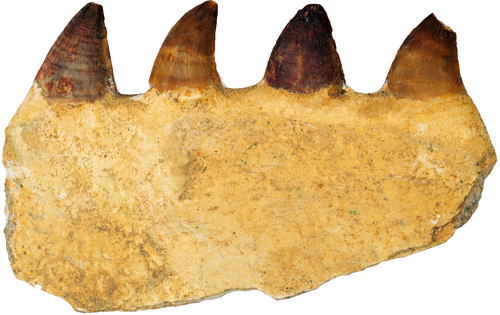
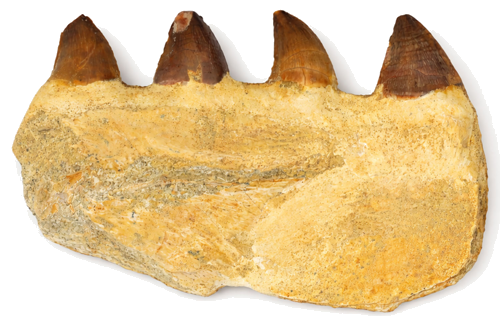
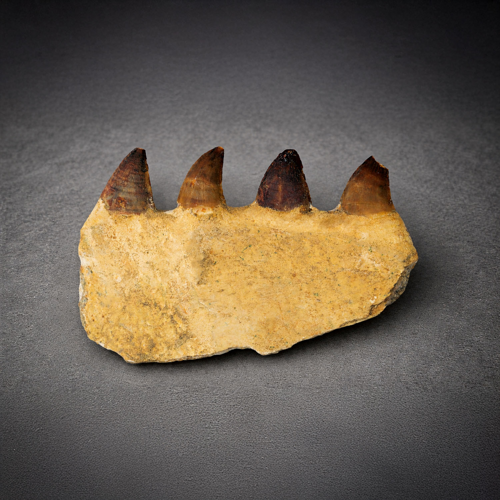
About the item: This impressive exhibit is an authentic jaw fragment of a Mosasaurus beaugei featuring four teeth, belonging to one of the most powerful apex predators of the Late Cretaceous oceans. Mosasaurs dominated marine ecosystems approximately 72–66 million years ago. Discovered in the famous phosphate mines of Morocco, this fossil is a direct testament to an era when giant marine reptiles occupied the very top of the food chain. It is not only a rare paleontological find but also a representative relic of prehistoric life that has survived through geological processes spanning millions of years.
Technical Information:
Title: Mosasaur jaw fragment with teeth
Species: Mosasaurus beaugei
Period: Late Cretaceous (~72–66 million years)
Region: Oued Zem phosphate mines, Morocco
Dimensions: 304 × 150 × 62 mm
Number of teeth: 4 original teeth
Material: Fossil bone and enamel, mineralized matrix
Condition: Stabilized with specialized conservation agents; teeth are professionally secured within the jaw structure.
Authenticity: Original fossil
Artistic and Morphological Analysis: The specimen is characterized by an archaic, monumental aesthetic. The jaw fragment has retained its natural bone texture, providing a base for the four conical teeth. Mosasaur teeth are known for their robust enamel surface and unique morphology designed to grip and tear large prey. The contrast between the dark tooth enamel and the lighter jaw matrix creates a visually dynamic composition. Reaching 30 cm in length, this fragment gives the exhibit a tangible weight and scale, allowing one to perceive the true magnitude of this prehistoric predator.
Social and Cultural Context: Mosasaurs are often referred to as the "T-Rex of the Late Cretaceous oceans." These reptiles, which could grow to lengths of 10–15 meters, represented the pinnacle of evolution adapted for life in the open seas. From a scientific perspective, jaw fragments with teeth are among the most significant finds for understanding the diet and hunting habits of these animals. In the collector's market, Mosasaurus beaugei specimens from Morocco are highly valued for their aesthetic fossilization and symbolic significance—as an object representing one of the mightiest predators in Earth's history.
Provenance: The fossil was discovered in the Oued Zem region of Morocco. This area is globally recognized as one of the most productive sites for Late Cretaceous marine fauna. This is an original find that enhances any natural history or paleontology collection with an authentic and visually striking centerpiece.