
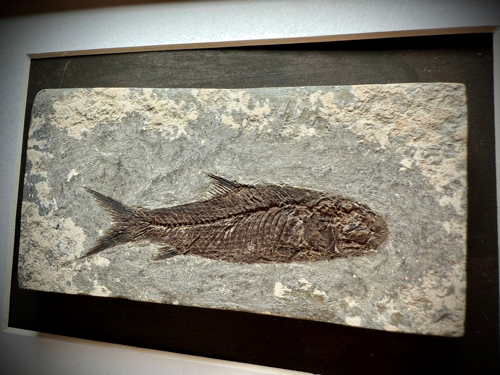
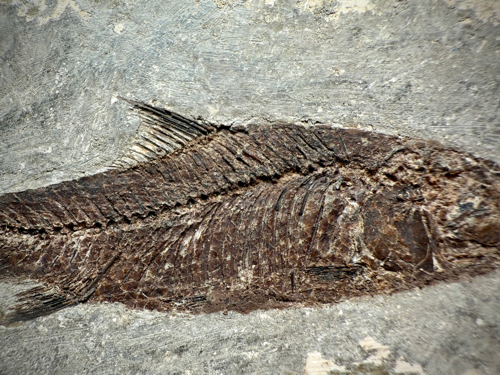
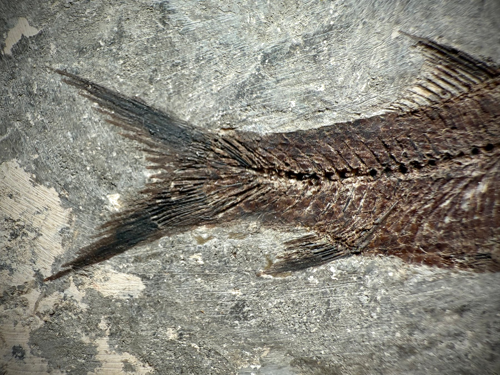
About the Object: An authentic, impressive prehistoric ray-finned fish Jianghanichthys hubeiensis fossil from the Paleogene system, Eocene epoch – an exceptional specimen of Cenozoic era paleofauna, formed 56–33.9 million years ago. This specimen in its natural state represents an extinct species of freshwater fish, whose perfectly preserved fossil remains are a valuable witness to early Cenozoic aquatic ecosystems. The fossil features professional paleontological preparation and high anatomical detail, which is why it has received wide recognition among international collectors and prestigious museums worldwide.
Technical Information:
The scientific name is Jianghanichthys hubeiensis.
The specification is an impressive prehistoric ray-finned fish (Stunning prehistoric ray-finned fish).
The geological system is Cenozoic.
The period/epoch is Paleogene / Eocene (56–33.9 million years ago).
The condition is natural (Natural).
The provenance indicates that the source is associated with long-term, professional fossil hunting and preparation activities in various countries around the world. Specimens prepared by this author are preserved in private collections in the United States, Singapore, Taiwan, as well as in famous museum exhibitions in the United Kingdom, China, and Japan. Logistics are managed to ensure the highest level of security and reliability.
Artistic and Structural Analysis: This specimen demonstrates a perfectly articulated, horizontal position of the fish skeleton, deeply pressed into a rectangular sedimentary matrix. The anatomy of the fish is revealed with great precision: the spinal axis, dense rib bones, skull structure, and the dorsal, ventral, and powerful tail fins are clearly visible. The dark, brown texture of the fossilized body creates a highly expressive, natural contrast with the light gray, relief rock matrix, while the surrounding dark framing further enhances the visual depth of the object. Careful preparation allowed the release of fragile bone elements without changing the original properties of the rock at all.
Historical and Geographical Context: During the Eocene epoch, following the great extinction of the dinosaurs, Earth's climate was extremely warm, and vast, isolated freshwater lake and river basins formed deep within the landmasses. Jianghanichthys hubeiensis was one of the characteristic lake inhabitants of the Asian region (especially China's Jianghan basin), belonging to the order Cypriniformes (carp-like fish). Due to specific conditions – rapid burial by lake sediments in shallow waters and mineral-saturated water – the bodies of these fish were instantly preserved in fine-grained mud, protecting the delicate fin rays from decay and creating unique geological chronicles of time.
Collection and Investment Significance: The market value of this prehistoric fish is defined by several key factors. First, it is the highest quality of preparation, achieved through decades of expeditions and meticulous work in laboratories, which guarantees a museum-level specimen. Also valuable is the completely natural condition of the object without industrial modifications or chemical embellishments, ensuring a stable price in the paleontology market. The international footprint – the fact that fossils from this source are recognized by museums in the UK, China, or Japan, as well as by collectors in the US and Singapore – provides the object with an unquestionable guarantee of prestige and investment security. Due to its exceptional aesthetic appearance, clear anatomical structure, and reliable handling, this fossil slab will become a highlight of precious Cenozoic find collections or a luxurious, intellectual interior detail.
This approximately 50-million-year-old Eocene epoch masterpiece is an authentic document of ancient freshwater basin life, harmoniously combining scientific weight, highest-level master preparation, and long-term collectible potential.