
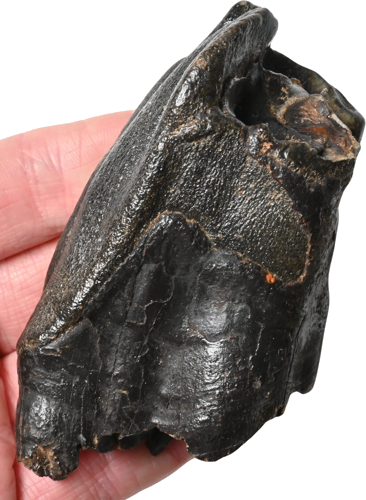
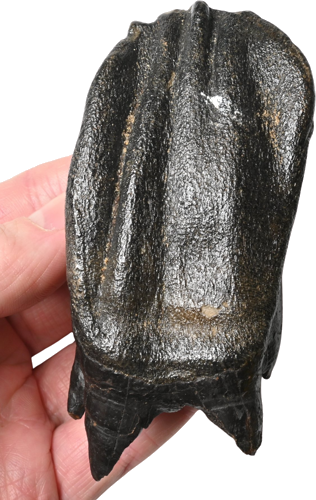
About the item: An authentic Pleistocene epoch fossil tooth from the upper jaw (maxilla) of a woolly rhinoceros (Coelodonta antiquitatis) – a unique Ice Age megafauna artifact formed 2.58–0.0117 million years ago in the Amur region of Eastern Siberia. This impressive, deep black specimen represents one of the most iconic mammals of the Quaternary period, adapted to the harsh conditions of the tundra-steppe. Valued for its excellent preservation of anatomical structures, natural texture, and scientific significance, this tooth possesses high collectible potential and strong visual expression.
Technical information:
The height of the specimen is 4.5 cm, the width is 9.5 cm, and the depth is 4 cm.
Its origin is the Amur region, Eastern Siberia, Russia.
The geological system is the Quaternary period, specifically the Pleistocene epoch (2.58–0.0117 million years).
The condition is natural.
Conservation has been professionally carried out, with the piece stabilized and protected using specialized "Paraloid B-72" resin.
Artistic and structural analysis: This find demonstrates a massive, beautifully articulated molar tooth of a woolly rhinoceros. The fossil stands out due to its rich, glossy black color, determined by specific mineralization in the Siberian permafrost and river sediments. The enamel surface retains its authentic, rugged texture with clearly visible ridges (lophs) on the chewing surface and deep depressions, which were adapted for grinding tough steppe vegetation. The object has been professionally conserved with the paleontologically recognized material "Paraloid B-72", which reinforces the bone structure and protects it from environmental factors without visually altering the tooth's primary authenticity.
Historical and geographical context: Woolly rhinoceroses (Coelodonta antiquitatis) were among the largest mammals of the Late Pleistocene, dominating northern Eurasia alongside woolly mammoths. Their bodies were covered in dense fur, and they boasted two massive horns on their snouts. The Amur region in Eastern Siberia features unique sedimentary properties where Pleistocene fauna remains are perfectly preserved due to low temperatures and a specific soil composition. The tooth structure of this species is an extremely important evolutionary testament, revealing how these animals managed to survive in the fierce glacial climate by feeding on prickly tundra vegetation.
Collectible and investment value: The value of this fossil tooth is defined by several essential criteria. Its anatomical value lies in it being a complete and clearly articulated upper jaw tooth with a perfectly visible masticatory relief. Its aesthetic appeal is heightened by the rare, deep black enamel color and natural luster, giving the object a sculptural presence. Professional conservation through treatment with "Paraloid B-72" guarantees the long-term stability of the fossil and protects it from crumbling. Finally, its historical popularity ensures that exhibits of Ice Age megafauna (mammoths, woolly rhinos) remain among the most sought-after and consistently valued collector items on the international market. This is an impressive, thousands-of-years-old relic of the glacial epoch – an authentic document of prehistoric nature combining scientific weight, flawless preservation quality, and solid collectible value.