
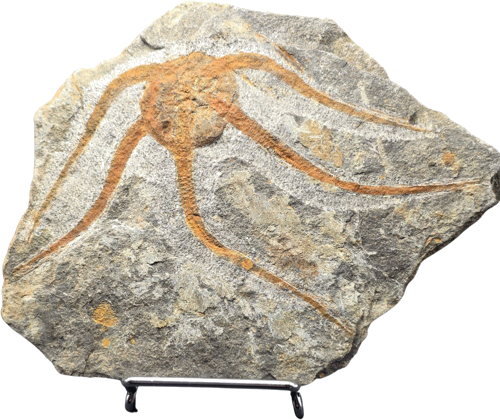
About the item: An authentic brittle star (Ophiuroidea) fossil—a close relative of the starfish—in a rock slab from the Ordovician period: a rare geological artifact formed 485.4–443.8 million years ago in the northwestern part of the Sahara Desert, in present-day Moroccan territory. This specimen of the Echinodermata phylum represents one of the first more complex life forms to inhabit our planet's oceans. Valued for its excellent level of preservation, contrasting natural pigmentation, and scientific significance, this fossil is a superb example of so-called "living fossils," characterized by exceptional aesthetic appeal.
Technical information:
The height of the specimen is 15 cm.
Its origin is Northwestern Sahara, Morocco.
It belongs to the Paleozoic era, Ordovician period (485.4–443.8 million years).
The condition is Enhanced—the natural outline has been optically highlighted for a better visual effect.
The conservation is stabilized, fully ready for display.
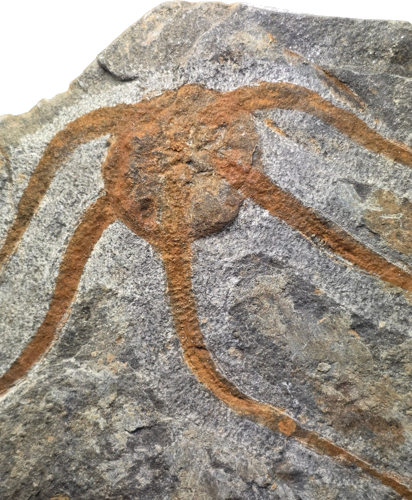
Artistic and structural analysis: This find demonstrates the classic anatomy of a brittle star (ophiuroid) impressed upon a gray limestone matrix. The specimen features a beautifully defined, disk-shaped central body from which long, graceful, and flexible arms (limbs) open radially. The warm orange hue of the fossil, determined by iron oxides, creates a striking color contrast with the rough, gray surface of the background rock. The wavy limbs gracefully arranged within the rock create a dynamic impression of movement—resembling a prehistoric dance—revealing the subtle elegance of this organism's structural design.
Historical and geographical context: During the Ordovician period of the Paleozoic era, global sea levels reached one of the highest points in Earth's history, and the temperature of tropical seas exceeded 43°C (110°F) in places. These unique conditions led to a massive diversification of marine life—it was then that true starfish (Asteroidea) and brittle stars (Ophiuroidea), belonging to the genus Ophiura, diverged from each other. At that time, the current territory of Morocco was the floor of a shallow, life-teeming ocean. Brittle stars used their flexible limbs for active movement along the seabed and, feeding on organic particles and small mollusks, occupied an important niche in ancient ecosystems.
Collectible and investment value: The value of this echinoderm fossil is defined by several key aspects. Its evolutionary significance stems from representing a classic example of a "living fossil" whose anatomy has remained virtually unchanged for half a billion years. Its visual aesthetics lie in the sharp contrast of orange limbs against gray stone, creating a graphic, natural picture. Its scientific value illustrates the flourishing of marine fauna during the Ordovician period and perfectly retains the taxonomic features of the genus. Finally, its collectible versatility, due to its 15 cm dimensions and stable base, makes the object ideally suited for both specialized paleontology collections and exclusive interior accents. This is a unique marine deep-sea relic nearly 450 million years old—an authentic work of natural art harmoniously combining deep historical value, scientific precision, and exceptional visual character.