
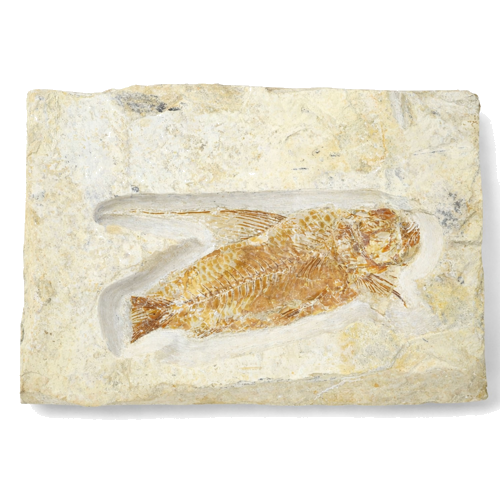
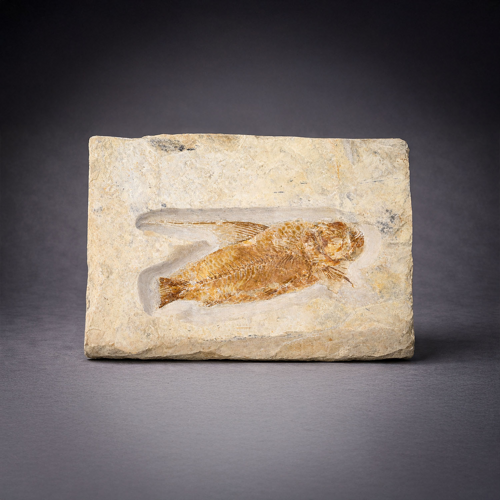
About the item: A well-preserved skeleton of a ray-finned fish (Nematonotus) that lived in the seas of the Late Jurassic period approximately 163.5–145 million years ago. The fossil was found in Lebanon, a region famous for exceptionally well-preserved finds of Jurassic marine organisms. The sedimentary rocks of this area allow for the preservation of even fine skeletal structures, making Lebanese fossils highly valued from both scientific and collectible perspectives.
Technical Information:
Object: fossil fish skeleton
Species: Nematonotus
Animal type: prehistoric ray-finned fish
Geological period: Late Jurassic Age: ~163.5–145 million years
Discovery location: Lebanon
Dimensions: 12 × 15.5 cm
Weight: 700 g
Type of fossilization: skeleton in a limestone slab
Condition: natural, without restoration
Processing: none applied
Authenticity: original fossil
Scientific and Morphological Analysis: Nematonotus was a ray-finned fish (Actinopterygii) belonging to an ancient group of bony fish that inhabited the warm oceans of the Jurassic period. These fish were an important part of the food chain between smaller organisms and larger predators. The specimen features a clearly visible complete skeleton laid out in a natural position within the limestone slab. The primary skeletal structures, spine, fin bones, and body outlines are well-defined. This type of fossilization occurred when the organism was rapidly covered by fine sediments, which protected it from decay.
Preservation and Authenticity: The fossil is in its natural state, without restoration or additional processing. It is an authentic paleontological find that has maintained its original structure for more than 150 million years. This specimen serves as direct biological evidence of an extinct species that lived in Earth's ancient oceans long before the extinction of the dinosaurs.
Collectible Value: This Jurassic ray-finned fish fossil specimen is valuable due to its clearly preserved skeleton and excellent state of conservation. Because of its authenticity and representative appearance, the object is suitable for natural history, fossil, or prehistoric life collections.