
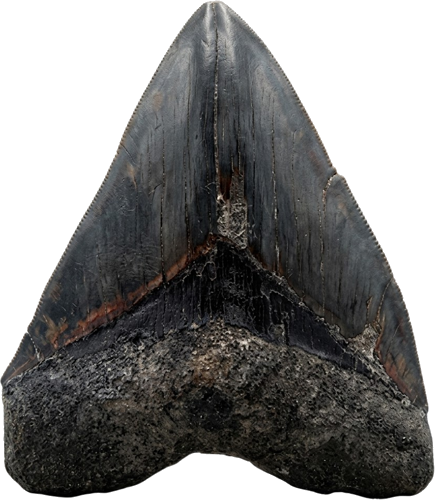
About the item: This impressive fossil tooth belongs to the Megalodon (Carcharocles megalodon) – one of the largest and most powerful predators in Earth's history. The Megalodon dominated the world's oceans during the Neogene period, approximately 23–3.6 million years ago. Since shark skeletons are composed of cartilage, which rarely fossilizes, teeth are the most significant evidence of this prehistoric giant's existence. This specimen, found in Indonesia, is an authentic biological fragment that offers a direct connection to the legendary marine predator, whose power and size have become a symbol of prehistoric nature.
Technical Information:
Title: Megalodon tooth
Species: Carcharocles (Otodus) megalodon
Period: Neogene (~23–3.6 million years)
Region: Indonesia, Java, Cikalong
Material: Fossil enamel, mineralized tissue
Tooth length: 14.6 cm
Morphology: Broad triangular tooth with serrated edges (serrations)
Condition: Restored, with preserved original enamel
Classification: Otodontidae family, extinct shark species
Authenticity: Original fossil
Artistic Analysis: The specimen features the classic morphology of a Megalodon tooth – a sharp triangular shape that radiates primal power. The natural fossil enamel remaining on the surface provides the object with aesthetic depth, while the fine serrations (saw-like edges) emphasize the tooth's functional brutality. The length of 14.6 cm lends the object monumentality, turning it not just into a scientific find, but also an impressive natural sculpture. The color palette and texture formed by natural fossilization processes make each such tooth a unique work of art from natural history.
Social and Cultural Context: The Megalodon is considered the pinnacle of evolution among marine predators; it is estimated that it could reach up to 20 meters in length and weigh over 100 tons. Its teeth were adapted for hunting large marine mammals, including early whales. Due to its size and influence in popular culture, the Megalodon has become one of the most recognizable prehistoric species in the world. In paleontology and collecting communities, such teeth are valued not only as scientific artifacts but also as prestigious collectible objects representing the grandeur of the oceans and the passage of time.
Provenance: The fossil was found in the Cikalong region, Java Island (Indonesia) – an area famous for its abundant and high-quality finds of Neogene period marine fauna. This is an original fossil that enriches natural history collections with an authentic witness to prehistoric life.