
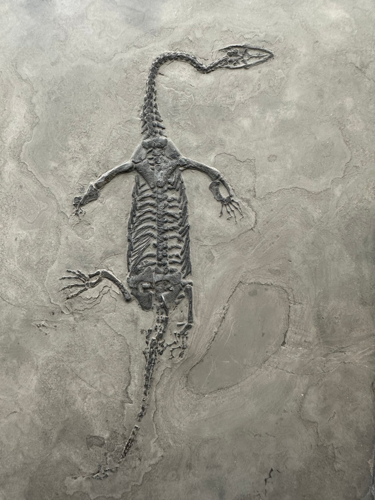
About the item: An authentic Triassic period marine reptile fossil of Keichousaurus sp. – a prehistoric life artifact of impressive size, formed 251.9–201.3 million years ago in the territory of present-day China. This specimen represents an extinct genus of the order Sauropterygia, preserved in its natural rock matrix. The fossil features a complete, anatomically articulated skeletal structure, excellent three-dimensional detail prominence, and larger-than-usual dimensions. Valued for its professional preparation without structural damage, this find possesses solid aesthetic value and strong collectible appeal.
Technical information: Height: 26 cm Width: 18.5 cm Depth: 1.4 cm Origin: Guizhou Province, China Geological system: Mesozoic Period: Triassic (251.9–201.3 million years) Condition: Natural, complete articulated skeleton (approx. 25 cm long) Conservation: Professionally cleaned via sandblasting, stabilized
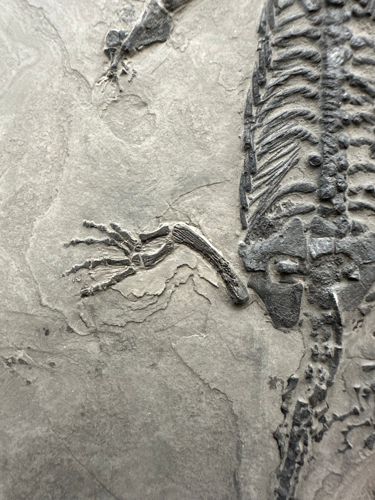
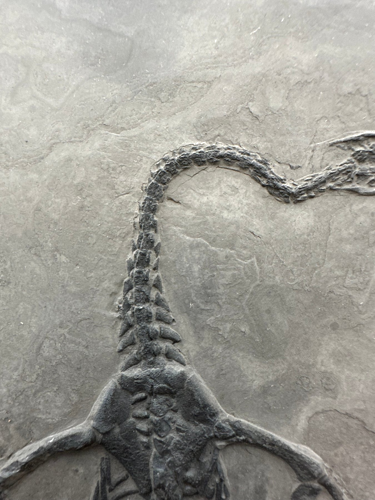
Artistic and structural analysis: This specimen demonstrates a complete and exceptionally long marine reptile skeleton from the dorsal side, retaining its integral biological architecture. Highly articulated anatomical structure: the chain of vertebrae, rib cages, tail axis, and tiny limb bones are clearly visible. Specific morphological features, especially the strongly pronounced, massive sternum and skeletal proportions, allow for identifying it as a male individual. Advanced sandblasting methods were applied to expose the fossil, protecting the fragile bone microstructure from damage (unlike harsh mechanical grinding); therefore, the skeleton emerges three-dimensionally within the rock, retaining maximum authenticity.
Historical and geographical context: The genus Keichousaurus was named after Guizhou Province in China, where the first traces of these animals were discovered in 1957. These small marine reptiles belonged to the family Pachypleurosauridae and dominated the shallow tropical waters of the Triassic period, becoming completely extinct during the Triassic-Jurassic mass extinction. Because they are frequently found completely intact and anatomically articulated, they provide invaluable information about the evolution of ancient marine ecosystems and the adaptation of reptiles to an aquatic lifestyle.
Collectible and investment value: The market value of this specimen is defined by several key aspects: Preparation quality – the skeleton exposed by sandblasting retains maximum depth of detail and natural bone texture. Exceptional size – the complete reptile skeleton at approximately 25 cm long is larger than standard finds of this genus. Completeness of anatomy – a three-dimensional, fully articulated male skeleton with clearly defined taxonomic features. Authenticity – natural condition in the rock matrix, without artificial reconstructions or composite parts.
This is a relic of the Mesozoic era over 200 million years old – a representative prehistoric document harmoniously combining scientific significance, excellent proportions, and long-term collectible and investment potential.