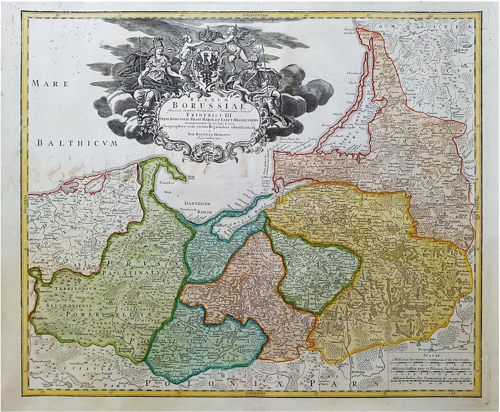
About the item: An authentic, spectacular large folio format (Folio Grande) 18th-century geographical map „Regnum Borussiae“ (Kingdom of Prussia) – an exceptional monument of the golden age of German cartography, published as a copper engraving circa 1730 in Nuremberg by the most famous German cartographer of the time, Johann Baptist Homann. This highly desirable collectible specimen represents the geopolitical view of Northeastern Europe and the Baltic region, originating from the foundational atlas „Atlas Novus Terrarum Orbis Imperia“ published by the author himself. The map is characterized by exceptional topographical detail, an ornate Baroque cartouche, and substantial, time-uncropped original margins.
Technical information: The overall dimensions of this large folio sheet are 63 cm x 54 cm. The work was printed in Nuremberg (Germany) and dates to circa 1730 (assigned to the 1400–1900 era, with the creation of the primary plate associated with the 1701–1720 period). The author and publisher of the map is Johann Baptist Homann. The technique is an original copper engraving on thick handmade paper with later hand coloring (Later hand colour). The condition of the item is assessed as excellent, considering its significant age and large dimensions. A vintage, professional, and masterfully applied conservative reinforcement (restoration) has been executed on the reverse side, which is virtually invisible from the front and in no way diminishes the aesthetic beauty or exceptional antique rarity of the work. This allows one to admire the clean margins, vibrant colors, and overall integrity of the image.
Artistic and structural analysis: This map represents the aesthetics of German cartography from the High Baroque era, where scientific geography intertwines with pompous heroic art. The upper central part is dominated by a grand allegorical cartouche engraved against a backdrop of clouds. At its center is a Latin dedicatory text dedicated to King Frederick I of Prussia (Frederick III, as Elector of Brandenburg, crowned King Frederick I of Prussia), above which two cherub angels (putti) hold the royal crown over the new coat of arms of Prussia. The composition is framed on the sides by ancient deities – Minerva (goddess of war and wisdom) and Mercury, along with attributes symbolizing military glory. The original engraving lines precisely capture riverbeds, forest masses, hilly terrain, and a dense network of settlements. Hand watercoloring is used as a structural element: it clearly delineates different territorial possessions and voivodeships, while water bodies – the Baltic Sea (Mare Balticum), the Curonian Lagoon (Curisch Haff), and the Vistula Lagoon (Frisch Haff) – are kept light, creating a superb contrast with the colorful landmass. A linear scale table (Scalae) is integrated in the lower right corner.
Historical and geographical context: J. B. Homann's map captures a highly important turning point in the history of Northeastern Europe – the proclamation of the Kingdom of Prussia in 1701, which completely shifted the balance of power in the Baltic region. Geographically, the map covers a wide area: Prussian lands, Pomerania, the Duchy of Courland and Semigallia with the Gulf of Riga, and a large part of the Polish-Lithuanian Commonwealth (Poland and Lithuania). This document is particularly valuable for Lithuanian history, as it depicts Samogitia, the territories of the Grand Duchy of Lithuania, the mouth of the Nemunas River, Klaipėda (Memel), and the Curonian Spit in great detail, with contemporary place names in Latinized form. Warsaw (Warsowia) and its surroundings within the Kingdom of Poland are also clearly visible. The Imperial Cartographer J. B. Homann (1664–1724) was known for his ability to synthesize the latest military and diplomatic topographical data; in short, this map served in its time as an official geopolitical guide for European rulers.
Collectible and investment value: The value of this Homann masterpiece in the antiques market is guaranteed by its grand format, sought-after regional context, and exceptional decorativeness. Cartographic sources of the Baltic region, Lithuania, and Prussia are in constant, stable demand among European bibliophiles and museums, and their value consistently grows over the years due to limited supply. The fact that the map has retained its full, wide margins and features very high-quality vintage conservation makes it a secure investment in cultural heritage.