
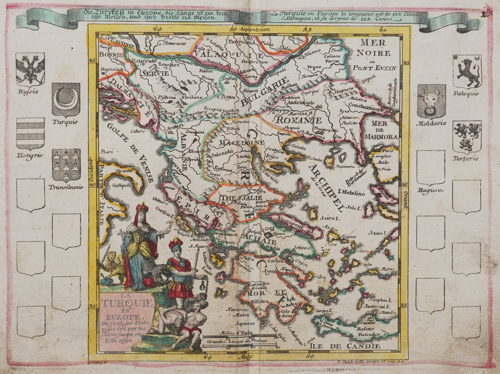
About the item: An authentic, extremely rare early 18th-century geographical map of Greece and the Balkan region "La Turquie en europe" – an exceptional monument of cartography and graphic art, created as a copper engraving by the renowned German artist and engraver Elias Baeck, also known by the pseudonym Heldenmuth. This compact format work features original, vibrant contemporary hand coloring, rich heraldic decoration on both sides of the frame, and a picturesque figurative cartouche. It is a highly rare collectible item reflecting the geographical and political landscape of the European territories ruled by the Ottoman Empire.
Technical information:
Map print size: 22 × 16 cm
Paper sheet size: 28 × 19 cm
Origin: Germany (Augsburg)
Era/Period: 1400–1900 (specifically 1721–1750, published in 1748)
Author/Engraver: Elias Baeck (E. B. a. H. / Heldenmuth, 1679–1747)
Technique: Copper engraving, hand-colored
Source of the work: Published in "Der curiose und in allen nöthigen Wissenschaften nützliche Dollmetscher oder allgemeines Zeitungs-Handbuch (...)", Augsburg, 1748 Condition: Good – the paper sheet has an original center fold, slightly dusty. There is a small, professionally repaired tear in the center of the upper white margin. The overall preservation of the image is very good.
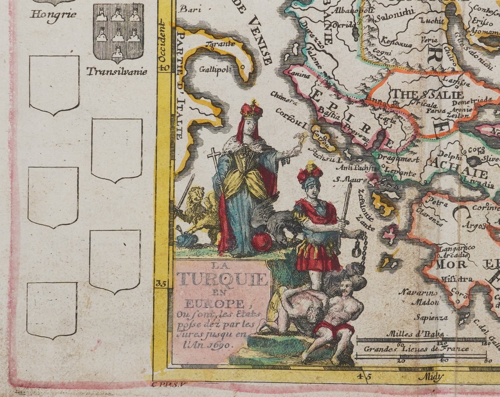
Artistic and structural analysis: This map demonstrates the decorativeness and density of information within a small area characteristic of the late Baroque era. The copper engraving lines precisely delineate mountain reliefs, river networks, and densely arranged city names in French. At the top of the map, elegant horizontal ribbon-bands provide a description of the territory's length and width in German and French. Arranged on both sides of the map's outer frame are the region's state and provincial coats of arms (Coats of Arms), among which the symbols of Russia (Rufsia), Turkey (Turquie), Hungary (Hongrie), Transylvania (Transilvanie), Wallachia (Valaquie), Moldavia (Moldavie), Tartary (Tartarie), and Ragusa (Raguse) are identified, while some shields are left blank. Integrated into the lower left corner is a figurative cartouche featuring sculpted figures of rulers, soldiers, and allegorical characters, along with a historical inscription about the empire's lands since 1690. The authentic coloring subtly highlights the contours of provinces (Bulgaria, Romonia, Macedonia, Thessaly, Achaea, etc.) and islands.
Historical and geographical context: The author of the map, Elias Baeck (1679–1747), was a versatile master of the Augsburg school who studied in Rome (where, due to his character, he earned the nickname "Heldenmuth" – heroic courage) and worked in Venice and Ljubljana. His signature "E. Baeck a. H. sculps." is clearly visible in the lower right corner of the map. The title "La Turquie en europe" (Turkey in Europe) reflects the geopolitical reality of the time, when the Balkan Peninsula, Greece, and the surrounding Aegean islands belonged to the Ottoman Empire. The map served as a practical supplement for contemporary press readers, helping them navigate international news and updates on military conflicts with the Austrian and Russian empires, which is why it was included in the popular Augsburg geographical handbook.
Collectible and investment value: The value of this map by E. Baeck in the antiques market is defined by several critical criteria. First of all, it is of exceptional rarity (Very rare) – due to intensive use, small pocket-sized reference maps have survived to this day in much smaller print runs than large atlas sheets. The heraldic element is also highly valued – the sequence of coat of arms shields on the sides makes this piece unique and visually appealing to collectors interested specifically in the history of the Balkans and the Ottoman Empire. Authentic contemporary coloring, excellent expressiveness of the frame and cartouche details, and minimal, professionally repaired signs of time guarantee the sustainable value of this object. This is an excellent investment in rare German cartographic graphic art, ideal for display, enriching private collections, or as a solid historical interior accent. This nearly three-hundred-year-old cartographic publication is an authentic document of Baroque history and warfare, harmoniously combining the engraving precision of Augsburg masters, great numismatic-cartographic rarity, and long-term enduring value.