
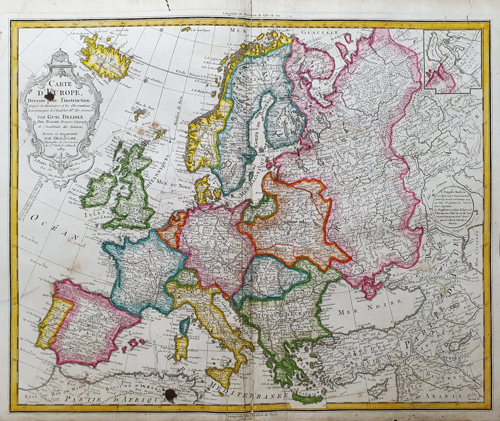
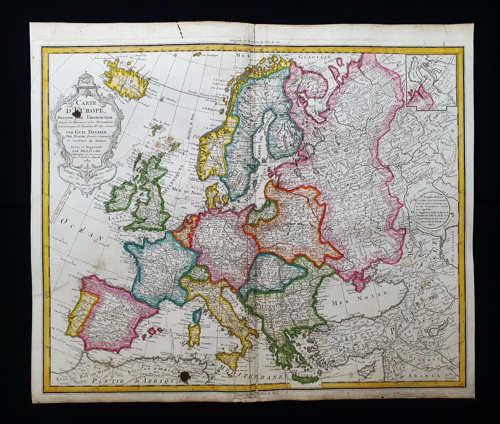
About the item: An authentic, large folio format (FOLIO) late 18th-century map of Europe "Carte d'Europe" – a monumental masterpiece of French cartography, created as a copper engraving by the renowned royal geographer Guillaume Delisle. This is a rare historical edition printed in France circa 1789 in his famous atlas "Atlas nouveau, contenant toutes les parties du Monde...". This work is characterized by incredible geographical detail at all points, wide margins, and later, highly aesthetic hand coloring (Later hand colour). Matching the scientific value of fossil or coin collections, this cartographic specimen is excellently preserved, demonstrates a stable condition, and possesses significant antique and investment potential.
Technical information:
Height: 55 cm
Width: 65 cm (Overall dimensions including margins)
Origin: France Era: 1400–1900
Period: Circa 1788 / 1804 (the description mentions the 1761–1780 period and the precise 1789 atlas date) Publisher and author: DELISLE (Guillaume Delisle)
Technique: Copper engraving on thick paper, hand-colored Condition: Assessed as very good and well-preserved – a few small spots from time are visible on the paper surface, and a conservative restoration/reinforcement (conservative restoration) has been applied to the reverse side of the sheet, which in no way compromises the map's aesthetic beauty or rarity.
Artistic and structural analysis: This impressive folio-format map demonstrates the highest precision of the French cartographic school. The copper engraving lines capture to the smallest detail the riverbeds, mountain reliefs, outlines of seas, and a multitude of city and regional names across the entire European continent. Integrated into the upper left corner is a large, luxurious Baroque-Classical style cartouche featuring plant motifs, architectural elements, and an official text indicating the contribution of G. Delisle and his successors. The hand coloring in watercolor harmoniously distinguishes the geopolitical borders of empires, kingdoms, and monarchies – the outlines of France, Spain, the Polish-Lithuanian Commonwealth (Poland and Lithuania), the Russian Empire, and Ottoman-ruled territories. The contrast between the colorful state outlines and the subtle cream paper base gives this large map exceptional graphic depth.
Historical and geographical context: Guillaume Delisle (1675–1726) entered history as the pioneer of modern scientific cartography in France, rejecting the outdated errors of Ptolemy and relying on precise astronomical observations and travelers' routes. This particular edition of the map, appearing around 1789 – on the eve of the French Revolution – captures an invaluable geopolitical view of Europe before the major territorial redrawings of the Napoleonic Wars began. The map covers the entire European space from Iceland and Scandinavia to the Mediterranean basin and the northern coasts of Africa, extending eastward deep into the vast expanses of the Russian Empire, reflecting the triumph of Enlightenment geographical science.
Collectible and investment value: The value of this map of Europe by G. Delisle in the international art and antiques market is guaranteed by its monumental folio format and the author's globally recognized name, driving constant demand among elite collectors. Since the map was issued with original wide margins and its reverse side has been professionally and conservatively reinforced, the paper is protected from further deterioration and is ideally prepared for framing. Small spots from time only confirm the item's age and historical authenticity without diminishing its visual impact. Such a decorative and scientifically valuable work is an excellent capital investment, an undeniable leader for future geographical exhibitions, and a prestigious accent in a luxurious private study, library, or classical interior.
This over two-hundred-year-old folio-format cartographic monument is an authentic document of Enlightenment science and French art, harmoniously combining historical weight, enduring aesthetics, and long-term investment value.