
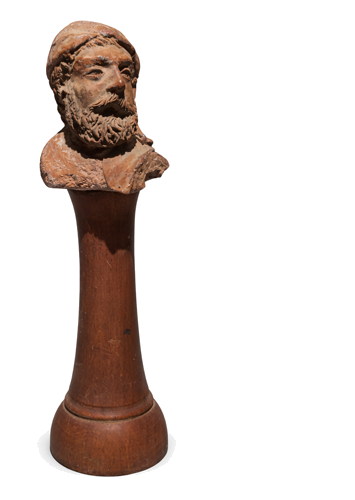
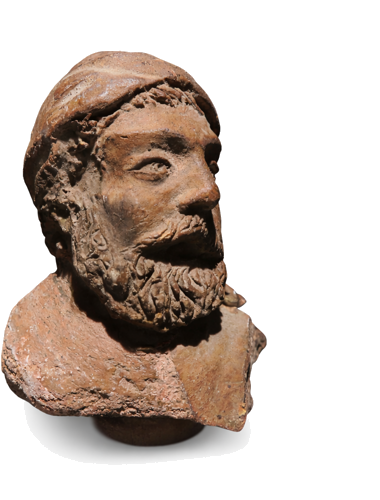
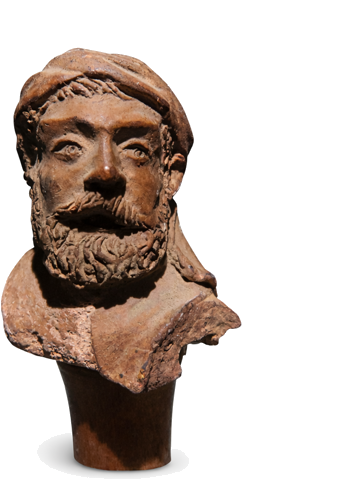
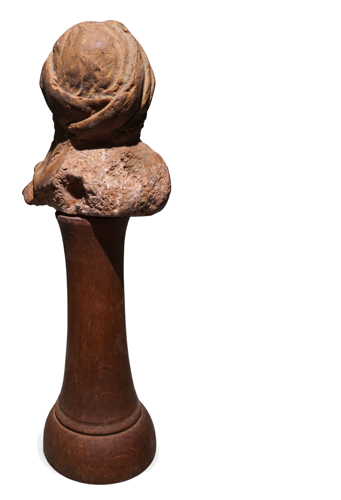
About the item: The Hellenistic period (~3rd–1st century BC) terracotta head sculpture is a historical fragment over two millennia old, offering an exceptionally close perspective on a person from the ancient world. Created during the Hellenistic era, it reflects one of the most prominent features of the period's art – the ability to convey individual character and a real-life human portrait in a small form. Although the work is compact, its plasticity is expressive: the mature male face is sensitively modeled, with clearly defined lines and vivid mimicry. This is an authentic expression of Hellenistic realism, where a small format merges with expressive plastic language.
Technical Information:
Title: Terracotta head sculpture
Period: Ancient Greece, Hellenistic period (3rd–1st century BC)
Region: Greece
Material: Terracotta
Technique: Hand-modeling and firing in a ceramic kiln
Height: 6.4 cm (with stand 16.2 cm)
Condition: Good, with natural ancient patina and slight signs of surface wear
Mounting: Metal stand (modern) Documentation: Certificate of Authenticity Legal
Status: Spanish export license included
Artistic Analysis: The sculpture depicts a mature male face with a thick beard and headwear resembling a soft cloth hood. The face is modeled with distinct features: deep eyes, a strong nose line, and a meticulously formed beard create an individualized portrait. The beard is shaped with rhythmic curls, creating a textural contrast with the smoother surfaces of the face, lending vitality to the sculpture. The headwear is formed with soft folds that naturally envelop the top of the head and create a compositional balance. Such plasticity demonstrates the master's ability to maintain plastic intensity in a small format, moving away from classical idealization toward the rendering of realistic character.
Social and Cultural Context: This object belongs to the cosmopolitan Hellenistic world, where Greek culture spread across vast regions following the conquests of Alexander the Great. In the cities of that time, artists increasingly turned toward the individual human and scenes of daily life. Terracotta sculptures were one of the most accessible and widespread forms of art, produced in numerous workshops. Portraits often depicted real members of society – travelers, philosophers, merchants, or craftsmen. This sculpture acts as a silent witness to the daily life of an ancient city, representing the social identity and cultural environment of the time.
Provenance: The origin and legal status of the object are clearly documented: Private collection: France (acquired before the 1970s) Documentation: Certificate of Authenticity included Legal Status: Spanish export license included