
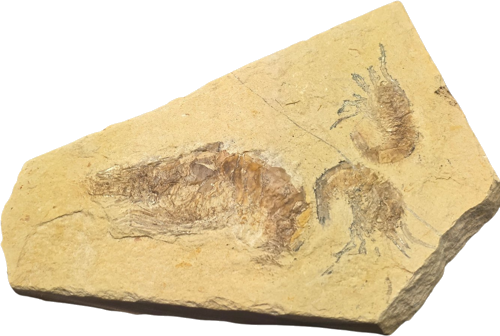
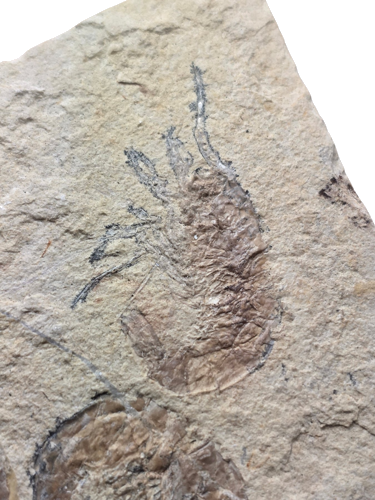
About the item: An authentic composition of prehistoric shrimp Carpopenaeus callirostris fossils in a rock slab from the Cretaceous period – a natural geological artifact formed 100.5–66 million years ago in the famous Hajoula deposits of Lebanon. These are perfectly preserved examples of an extinct marine life form, naturally imprinted within a light limestone matrix. Valued for its complete authenticity, dense multi-fossil composition, and deep historical significance, this specimen possesses a subtle aesthetic charm and a strong collectible value.
Technical information:
Height: 13 cm.
Origin: Hajoula, Lebanon.
Geological system: Mesozoic.
Period / Epoch: Late Cretaceous (100.5–66 million years ago).
Condition: Completely natural.
Conservation: Stabilized, prepared for display.
Structural and analytical breakdown: This specimen presents a highly aesthetic and dynamic composition of several shrimp within a single slab, dominated by one larger and two smaller individuals. The fossils exhibit subtle brownish and ochre pigmentation, which contrasts expressively with the soft, yellowish background of the limestone matrix. Due to exceptional sedimentation conditions, the fragile anatomical details of the arthropods are clearly visible in the rock: segmented shells (carapaces), abdominal segments, small legs, and graceful antennae. The completely natural condition without artificial reconstructions allows one to observe the authentic integrity of the biological architecture, preserved for millions of years.
Historical and geographical context: Lebanon's Cretaceous deposits, particularly those in the Hajoula region, are considered unique lagerstätten in the paleontological world, characterized by an incredibly detailed preservation of soft tissues. These localities hold a very deep historical memory: the ancient Greek historian Herodotus mentioned them in his chronicles, marveling at the fish in stones found in the mountains of Lebanon. During the Late Cretaceous period, this territory was covered by the warm, shallow Tethys Ocean, in whose calm, oxygen-poor bottom mud layer the fragile marine crustaceans were instantly buried, protecting them from decay.
Collectible and investment value: The market value of these Lebanese shrimp fossils is defined by several key criteria. First and foremost is its naturalness – the specimen is maintained in a completely natural condition within the rock, without the use of artificial inlays, coloring, or shape corrections. The uniqueness of the composition also guarantees value, as several individuals of different sizes arranged on a single slab create a richer, livelier, and more valuable exhibit than solitary finds. The anatomical detail contributes significantly to this, as the visibility of fragile crustacean parts, such as legs and antennae, testifies to the highest quality of fossilization. Finally, a special status is granted by historical prestige, given that fossils from the Lebanese region are one of the classic and most highly valued directions of paleontological collecting, enjoying stable demand on the international market. This is a marine deep-sea relic over 66 million years old – an authentic document of prehistory, in which the historical mystery that fascinated Herodotus blends with the subtle beauty of nature and long-term potential for collectible and investment growth.