
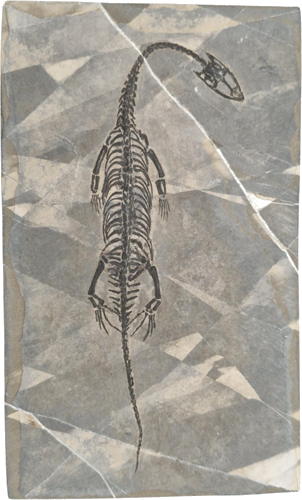
About the item: An authentic fossil of the marine reptile Keichousaurus hui from the Middle Triassic period – a stunning artifact of prehistoric life formed approximately 247.2–237 million years ago in the territory of present-day China. This immaculately preserved specimen, discovered in a dark layer of siltstone and mudstone, represents an extinct genus of sauropterygians. The fossil stands out for its exceptional anatomical detail, complete skeletal architecture, and natural calcite veins diagonally crossing the matrix. Valued for the quality of its handmade preparation, excellent detailing, and complete originality, this fossil possesses solid aesthetic charm and strong collectible appeal.
Technical information:
Height: 14.7 cm.
Width: 9 cm.
Depth: 1.3 cm.
Weight: 434 g.
Origin: Guizhou Province, China.
Geological system: Mesozoic.
Period / Epoch: Middle Triassic (247.2–237 million years ago).
Condition: Natural, completely original slab.
Conservation: Stabilized, professionally cleaned, and prepared for display.
Accessories: Information card and certificate of authenticity.
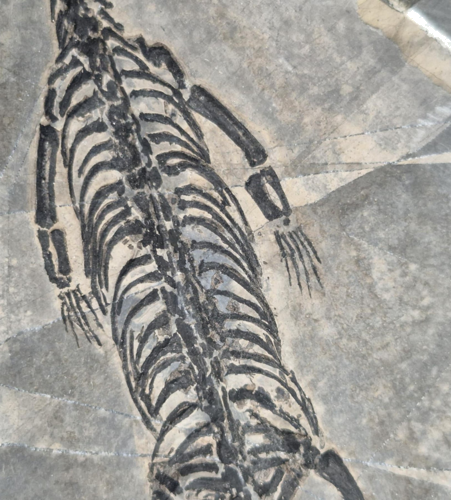
Structural and analytical breakdown: This specimen demonstrates a beautifully preserved reptile skeleton, approximately 12.6 cm long, which has maintained its intact biological structure. A graceful chain of vertebrae, a dense rib cage, the tail axis, and clearly defined phalanges are visible, testifying to the robust structure of the limbs. The dark silhouette of the skeleton creates an excellent graphic contrast with the grayish background of the stone matrix. A special geological highlight here is the clearly visible light-colored calcite veins – fissures that occurred during the rock formation and were later naturally filled with mineralized water. Although stone slabs often split precisely along these lines, this particular specimen avoided structural fractures and remained completely whole and undamaged.
Historical and geographical context: Keichousaurus hui were small marine reptiles belonging to the family Pachypleurosauridae. Due to their robust and stout limb structure, they are considered by scientists to be one of the essential evolutionary links illustrating the early adaptation of reptiles to marine ecosystems. These animals died en masse during the Triassic period due to powerful natural cataclysms, and their bodies were instantly buried under a thick layer of sediments and ash in Guizhou Province, which turned this region into one of the world's most important paleontological time capsules.
Collectible and investment value: The market value of this Keichousaurus fossil is defined by several key aspects. First and foremost is the exceptional quality of preservation – a completely original slab with natural calcite lines, showing no modern fractures or glue marks, which is highly prized among paleontology connoisseurs. The precision of the preparation is also valuable, as professional handwork in the laboratory allowed achieving a clear three-dimensional bone relief without damage. The complete package adds further value, as the included certificate of authenticity and information card ensure additional prestige and investment security for the item. Finally, the object features universal applicability, because due to its convenient proportions, this rare find is ideal for personal fossil collections, natural interior decor, or exclusive cabinets of curiosities. This Mesozoic era marvel, over 240 million years old, is an authentic document of prehistoric nature, in which scientific weight, geological history, and long-term collectible potential combine in perfect harmony.