
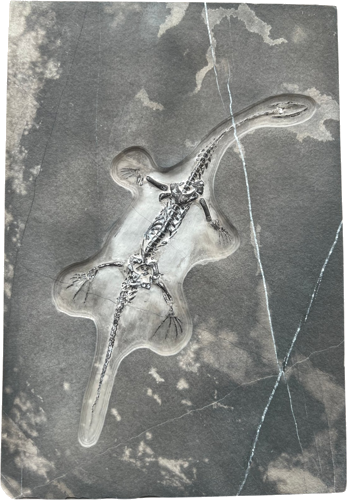
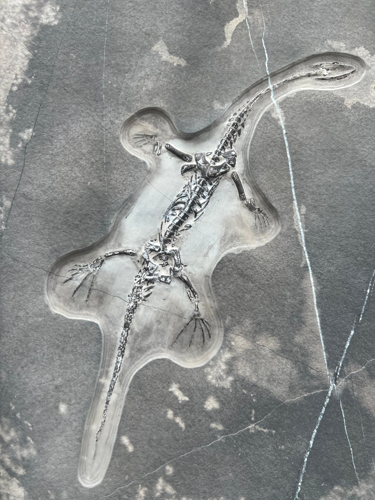
About the item: An authentic fossil of the marine reptile Keichousaurus from the Triassic period – a prehistoric life artifact of impressive size and exceptional preparation, formed in the Middle Triassic, Ladinian stage, approximately 242–237 million years ago in the territory of present-day China. This specimen represents an extinct genus of the order Sauropterygia, preserved in a dark carbonate rock. The fossil is distinguished by its flawless bone structure contrast, complete authenticity without any artificial coloration, and natural quartz vein inclusions. Valued for its deep, chemically achieved skeletal exposure and substantial dimensions, this find possesses museum value along with strong collectible and aesthetic appeal.
Technical information:
Height: 29.2 cm.
Width: 20.1 cm.
Depth: 1.1 cm.
Weight: 1792 g.
Origin: Xingyi, Guizhou Province, China.
Geological system: Mesozoic.
Period / Epoch: Middle Triassic (Ladinian, 242–237 million years ago).
Condition: Natural, 100% authentic.
Conservation: Professionally exposed using the acid method and subtly polished.
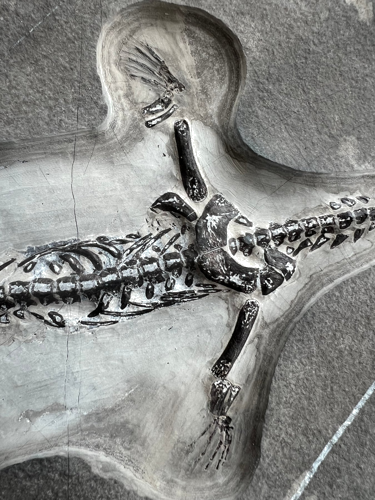
Structural and analytical breakdown: This large specimen demonstrates a beautifully articulated marine reptile skeleton that rises prominently in relief within the rock matrix, surrounded by an aesthetic lighter "halo" effect. Bone fossilization occurred on a phosphate basis, and the skeleton itself was cleaned using a highly precise and safe chemical method – the rock around the reptile was treated with diluted oxalic acid. Since the acid reacts only with the rock's calcium carbonate, turning it into an easily removable layer, but does not affect the bone calcium phosphate at all, the fragile skeletal architecture was ideally exposed without damaging microscopic features. The skeleton – from the elongated neck axis and vertebrae down to the tiny limbs – is visible with immense structural clarity. Light-colored lines running across the rock, which are naturally formed quartz veins, provide special visual charm and elements of natural decor.
Historical and geographical context: The genus Keichousaurus was named after China's Guizhou Province, where the most valuable and complete traces of these animals are still found today. These small marine reptiles belonged to the family Pachypleurosauridae and were excellently adapted to life in the water, flourishing in the shallow tropical oceans of the Middle Triassic. Their anatomy demonstrates the early evolution of reptiles and the transition from land to the marine environment. The geological layers of the Xingyi region are known to paleontologists worldwide as a unique time capsule, allowing the study of the Mesozoic era marine fauna boom prior to the mass Triassic-Jurassic extinction.
Collectible and investment value: The market value of this Keichousaurus fossil is defined by several key aspects. First is the exceptional size – a slab nearly 30 cm high and weighing over 1.7 kg is classified among the large, representative specimens of this genus. The unique preparation method is also highly valuable, as the acid exposure allowed for a deep, three-dimensional skeletal relief without scratches left by mechanical tools. The natural aesthetics contribute to its value, where the 100% authentic, unpainted dark skeleton contrasts with graceful white quartz lines. Finally, the object features universal applicability, because due to its sculptural quality and size, it is an ideal choice for serious fossil collections, naturalistic interior decor, cabinets of curiosities, or prestigious educational projects. This impressive relic of the Mesozoic era, over 230 million years old, is an authentic document of prehistoric nature, harmoniously combining high scientific weight, geological uniqueness, and monumental visual appeal.